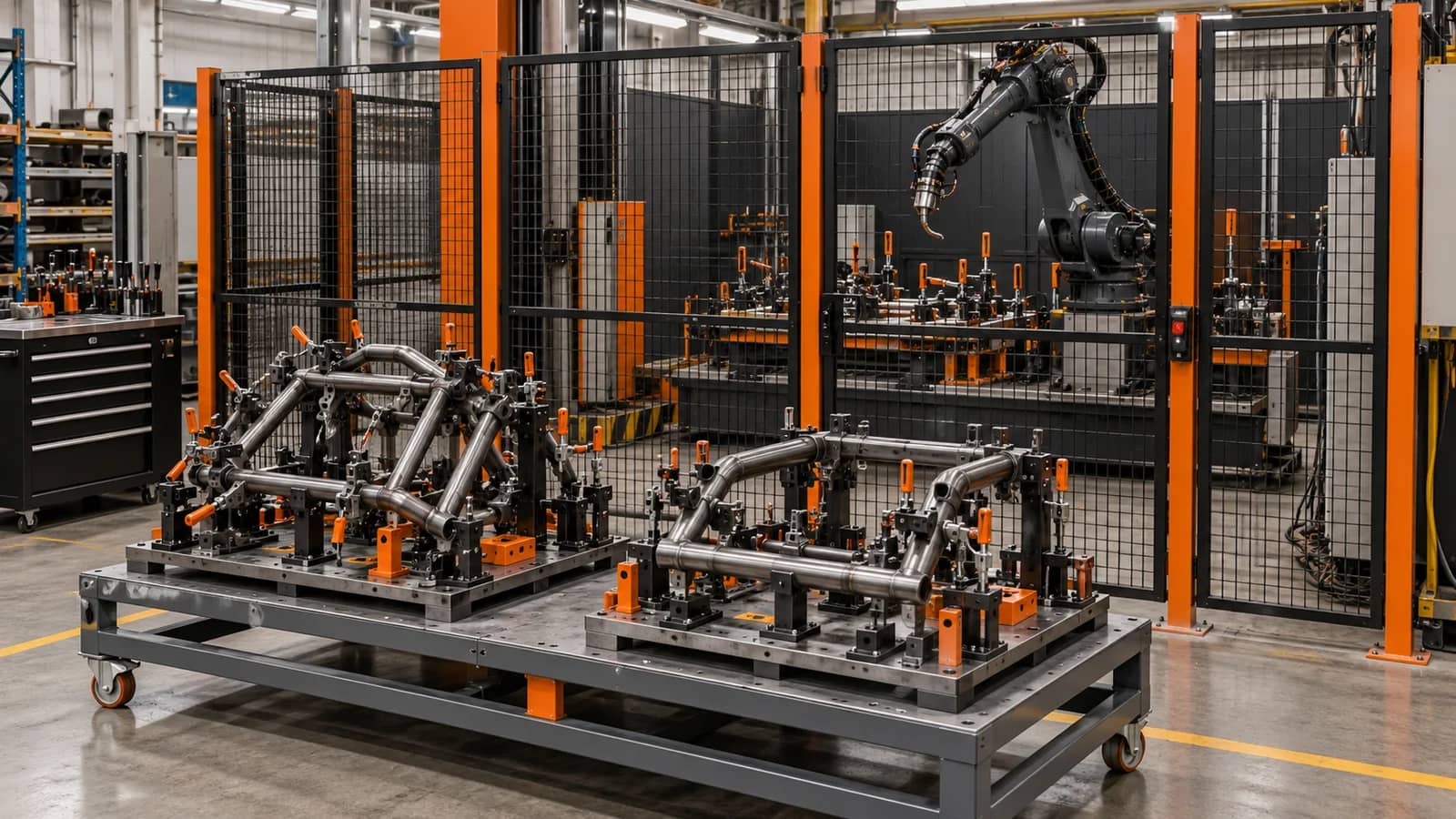
Define one transition before measuring time
Copy these fields into the setup sheet. Measure A→B and B→A separately when removal, cleaning or approvals differ.
- Start / finish
- Last accepted A part → first B part released under the agreed checks.
- Configuration bundle
- Part/drawing, fixture, robot program, weld recipe, tools and inspection revision.
- Resource / dependency
- Who can act, where, after which prerequisite and with which equipment.
- Release / exception
- Named quality decision, held-part identity and approved recovery route.
A task is offline only when it can finish independently of the stopped cell, without entering its hazardous area or borrowing a resource needed for current production.
Measure last-good to first-good, not fixture movement
A changeover includes more than removing a nest. Material identification, program selection, torch condition, checking the next assembly and waiting for a release decision can all keep the cell unavailable. State whether the finish event is first accepted part or stable production at an agreed condition; record both if they answer different planning questions.
Build a transition list from the actual product mix: shared-fixture recipe changes, insert changes and complete-pallet exchanges are different jobs. Group compatible parts using geometry, locating scheme, process and handling requirements, not the product name alone. Miller's manufacturer guidance includes part families and fixture-changeover downtime in the whole operation; the timing worksheet here turns that planning concern into named events.
Further reading: Miller — robotic welding planning and part families ↗
Three tasks, three planning boundaries
Stage and verify the next kit before stopping; retain resource and access constraints.
Exchange, connect and prove the installed state under approved instructions.
Check the trial, disposition held parts and authorize production; count waiting.
Separate offline preparation from stopped-line work
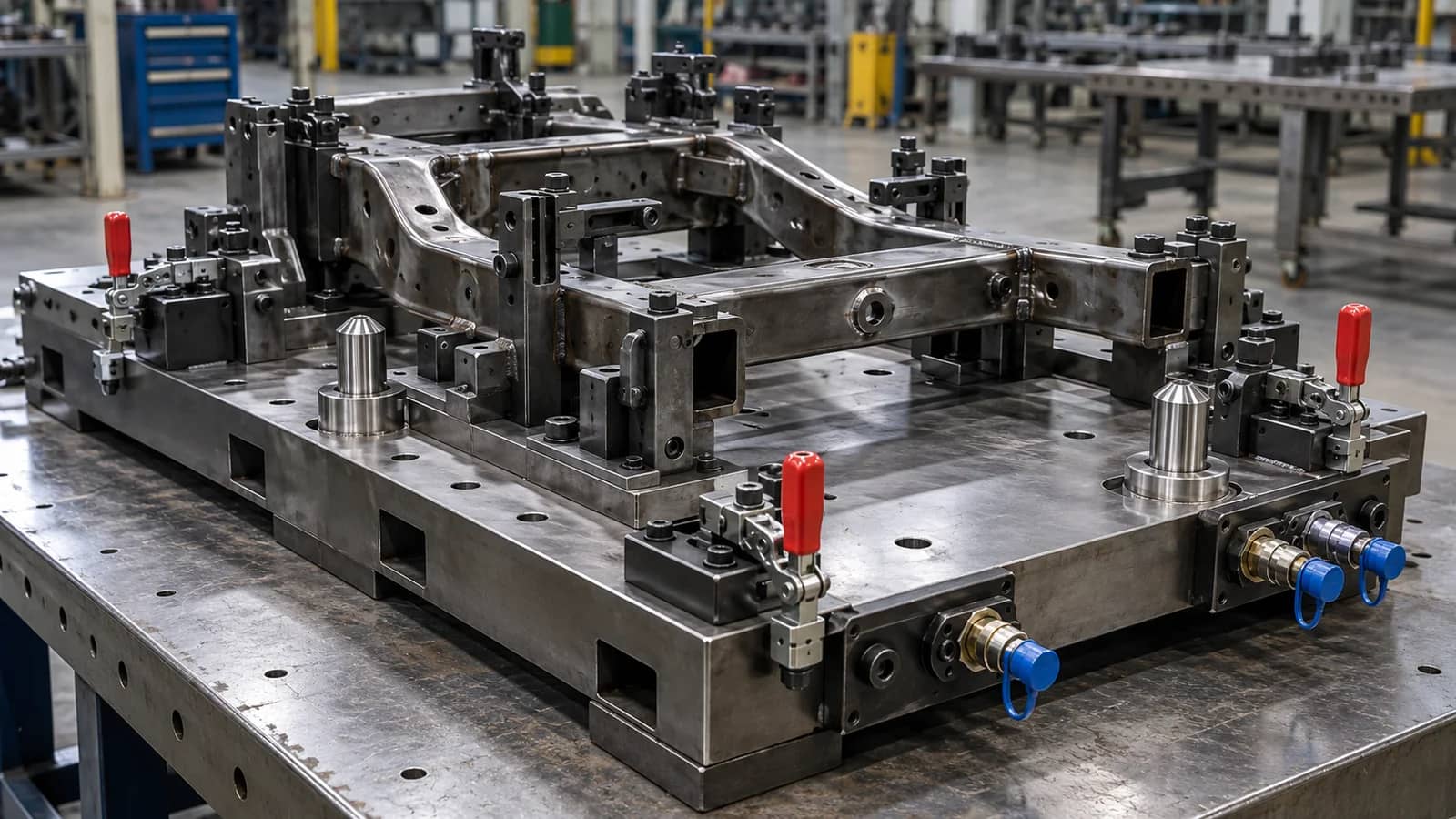
Before the current run ends, stage the correct material batch, inspect the replacement nest, check that required gauges are available and retrieve approved files. Record completion and any missing item. A nearby cart does not make a task ready if its fixture condition, lifting method or revision remains unresolved.
Removing the current fixture, connecting utilities and proving the installed configuration usually depend on an approved stopped-cell state. Follow the application's access, isolation and restart instructions; this planning sheet does not define an isolation procedure. Schedule shared technicians, cranes and inspection equipment explicitly. Work cannot overlap simply because two people are assigned to it.
Further reading: Premier Automation — welding fixtures and tooling ↗
Match fixture identity, locking and program revision
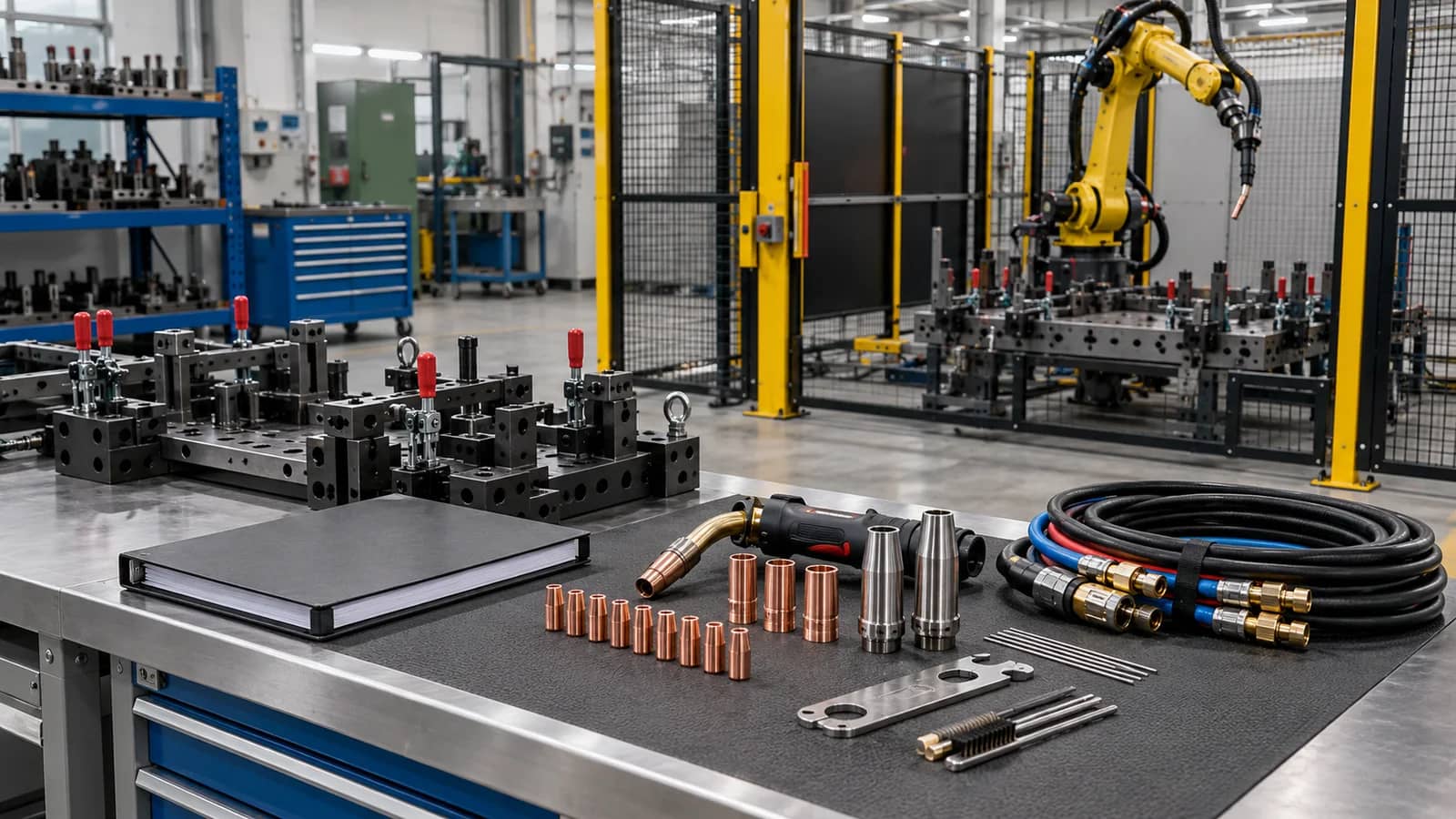
Define the allowed combination of part revision, fixture ID, insert set, robot program, weld recipe and positioner state. Check the locating surfaces separately from clamp or lock confirmation: a closed clamp does not identify the part revision. Include hose/cable routing, connections and the condition of locating wear parts in the setup record.
TTM's fixture-switching discussion connects installed fixture identity with control and program selection. For the buyer, the useful deliverable is a state/recipe table and a test for a mismatched or missing ID, conducted under the approved commissioning procedure. Specify who may load or change files, how backups are identified and which changes require another first-piece approval. A simulated path does not replace installed-cell verification.
Further reading: TTM — fixture changeover, identification and utilities ↗
From the next kit to a released configuration
Approved kit + people + gauges
Approved access and installation
Fixture + recipe + utilities + restart state
Identified part and agreed checks
Quality decision + stock disposition + handover
A dependency-based changeover time model
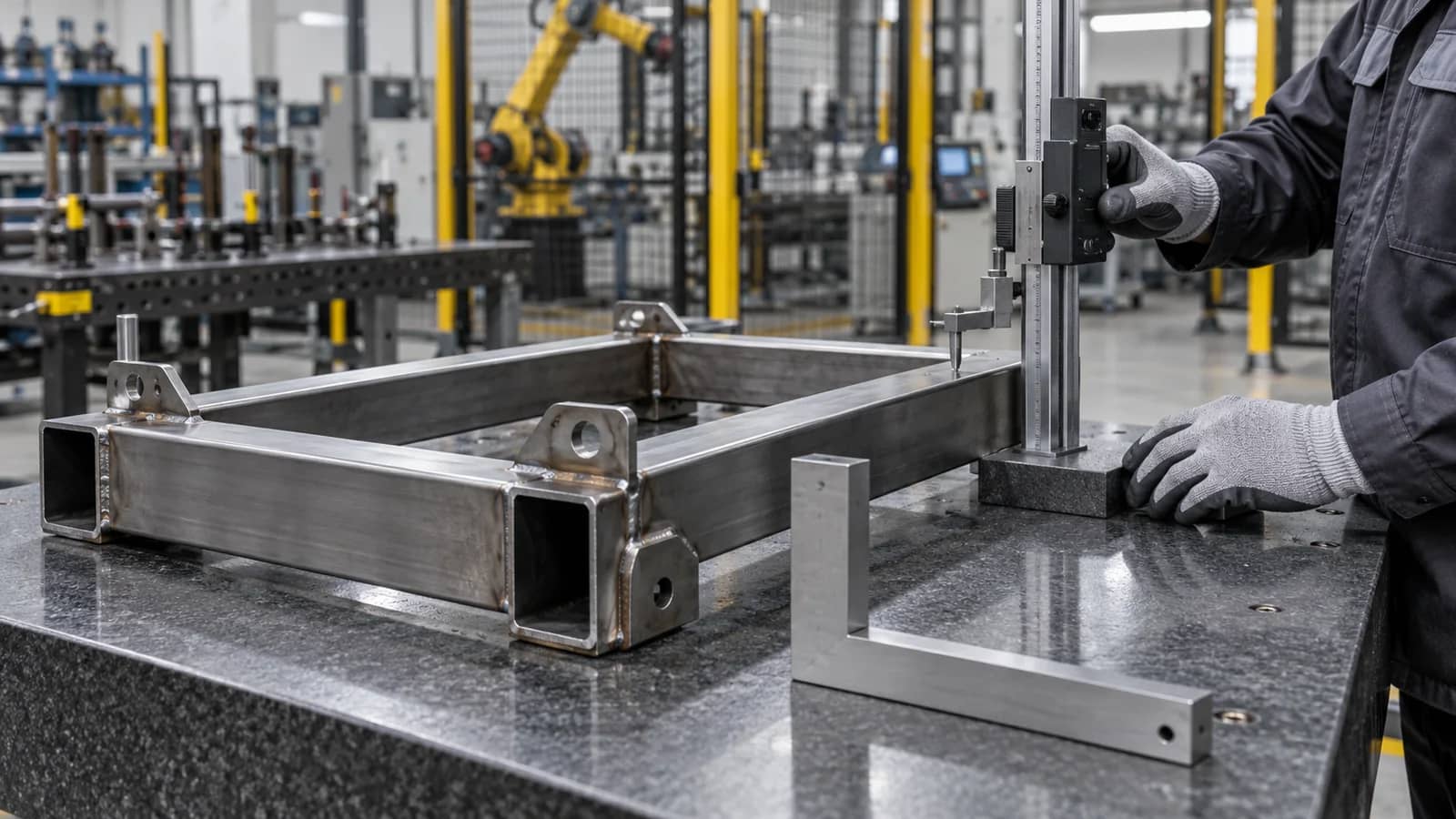
For each action record start, finish, predecessor, assigned resource and whether it occupies the stopped-line window. Elapsed changeover is the duration of the longest valid dependency path between the start and release events, including queues and waiting. Add serial tasks; for genuinely independent tasks with separate resources, use the longest parallel branch. Total labor-minutes sum all people's task time and are a separate measure.
Hypothetical assumptions, not measured performance: preparation 8 min, fixture exchange 6 min, configuration checks 4 min, consumable check 2 min, trial part 5 min and inspection/release 3 min. If all run serially after stopping, elapsed time is 8 + 6 + 4 + 2 + 5 + 3 = 28 min. If preparation is completed beforehand and the 4-minute configuration check can safely overlap the 2-minute consumable check with separate resources, stopped-line time becomes 6 + max(4, 2) + 5 + 3 = 18 min. Labor remains 28 person-minutes under these assumptions; only its placement changes. Replace every value and validate the overlap before using the result.
Run sensitivities on the constraint: an extra 7-minute inspection queue adds 7 minutes to either route; an unavailable setup technician can remove the assumed overlap. Track the actual spread by transition and reason rather than publishing one average. The model does not predict output, safety performance or investment payback.
Include first-piece approval and held material
Agree which dimensions, weld features and process records the first B part must satisfy, the inspection method and the authorized decision maker. Identify the trial piece and all subsequent pieces made before release. If the inspection needs cooling, sectioning or an external service, include that dependency and waiting in the plan instead of ending the clock at arc-off.
A rejected first piece returns to a defined cause-and-recheck route. Keep the original program/recipe and observed defect linked to the corrected version. Product acceptance criteria come from the applicable drawing, specification and quality plan; there is no universal first-piece sample size or weld threshold for every cell.
Plan abnormal recovery and the next shift
List credible interruptions: fixture ID mismatch, missing utility confirmation, damaged locating surface, unapproved file, failed trial or interrupted cycle. Define the stop/hold decision, person to contact and the evidence needed before restart. Restoring a previous configuration requires its own verified state and part identity; reverting a filename alone is insufficient.
At handover record the installed configuration, approved first piece, outstanding issues, segregated stock and current operator instruction. After maintenance or a program edit, assess which location, path, quality and recovery checks are affected. Use the same controlled checklist across shifts while keeping actual observations attached to each transition.
Changeover action, time and responsibility matrix
For your A→B transition add planned/actual duration, predecessor and named person to each row. O = offline candidate; S = stopped-line dependency; Q = quality release. These categories are planning prompts, not permission to overlap work or enter a cell.
Copy the rows into your RFQ or investment worksheet.
| Action | Input / timing boundary | Owner to assign | Completion evidence |
|---|---|---|---|
| Part family / revision | O: next schedule, drawing and route | Production planner + process engineer | Approved A→B configuration bundle |
| Material and kit | O: correct batch and complete change parts | Material handler / setup lead | Kit ID, batch and missing-item check |
| Replacement fixture condition | O: clean datums, wear, lifting/storage route | Tooling / maintenance | Inspection and handling readiness |
| Files and permissions | O: approved robot/PLC/recipe versions | Controls / welding process owner | Version list and recoverable backup |
| Access and removal | S: safe-state prerequisites and old-part clearance | Authorized setup team | Application-specific procedure completed |
| Locate and lock | S: seating, locks and installed fixture ID | Setup lead / tooling | Location and lock confirmations recorded |
| Utilities / routing | S: air, cooling, electrical and cable state as scoped | Maintenance / controls | Connections and required feedback checked |
| Program / recipe match | S: actual fixture and part versus selected files | Authorized programmer | Matching bundle; mismatch behavior verified |
| Torch and consumables | O/S: staged spares; installed condition confirmed | Welding technician | Specified setup condition and service record |
| Trial / first-piece checks | S/Q: approved restart, sample and inspection wait | Operator + quality authority | Part ID, measured results and disposition |
| Abnormal recovery | S/Q: hold, diagnose, restore and repeat affected checks | Controls / process / quality | Approved route and identified affected parts |
| Production handover | Q: release authority, instruction and held stock | Shift lead + quality | Released revision, open issues and elapsed time |
Changeover planning questions
When does a robotic welding changeover finish?
Define the finish event before timing. Last accepted A part to first released B part includes setup, trial, inspection and release waiting. If stable-rate production is also required, record that second milestone separately.
Can all setup work be moved offline?
No. Staging and file preparation may be independent, but removing the installed fixture, proving connections and verifying the installed state have cell-specific dependencies. Access, isolation, resources and restart conditions govern the sequence.
Does a quick-change fixture prove the program is correct?
No. Verify the part, fixture ID, insert set, program, weld recipe and relevant revisions as one allowed combination. Mechanical lock confirmation and configuration identity are different checks.
Is 18 minutes a recommended changeover target?
No. The 28- and 18-minute calculations are hypothetical assumptions that demonstrate dependency scheduling. Replace task times, resource availability, inspection waits and overlap permissions with project observations.
What should buyers send for a changeover review?
Send the part-family and revision list, expected A→B transitions, fixture and cell information, current program/recipe control, staffing constraints, actual timing observations and first-piece acceptance requirements. Identify which equipment and site responsibilities are in the requested quotation.
References and further reading
Define the next part transition with your RFQ
Send your part family, fixture approach, program/recipe baseline and acceptance requirements. TubeFrame can help organize configuration, interfaces and delivery responsibilities for project-specific review and quotation.
Discuss a welding-cell configuration ↗